Close-ups
Framed and on the wall
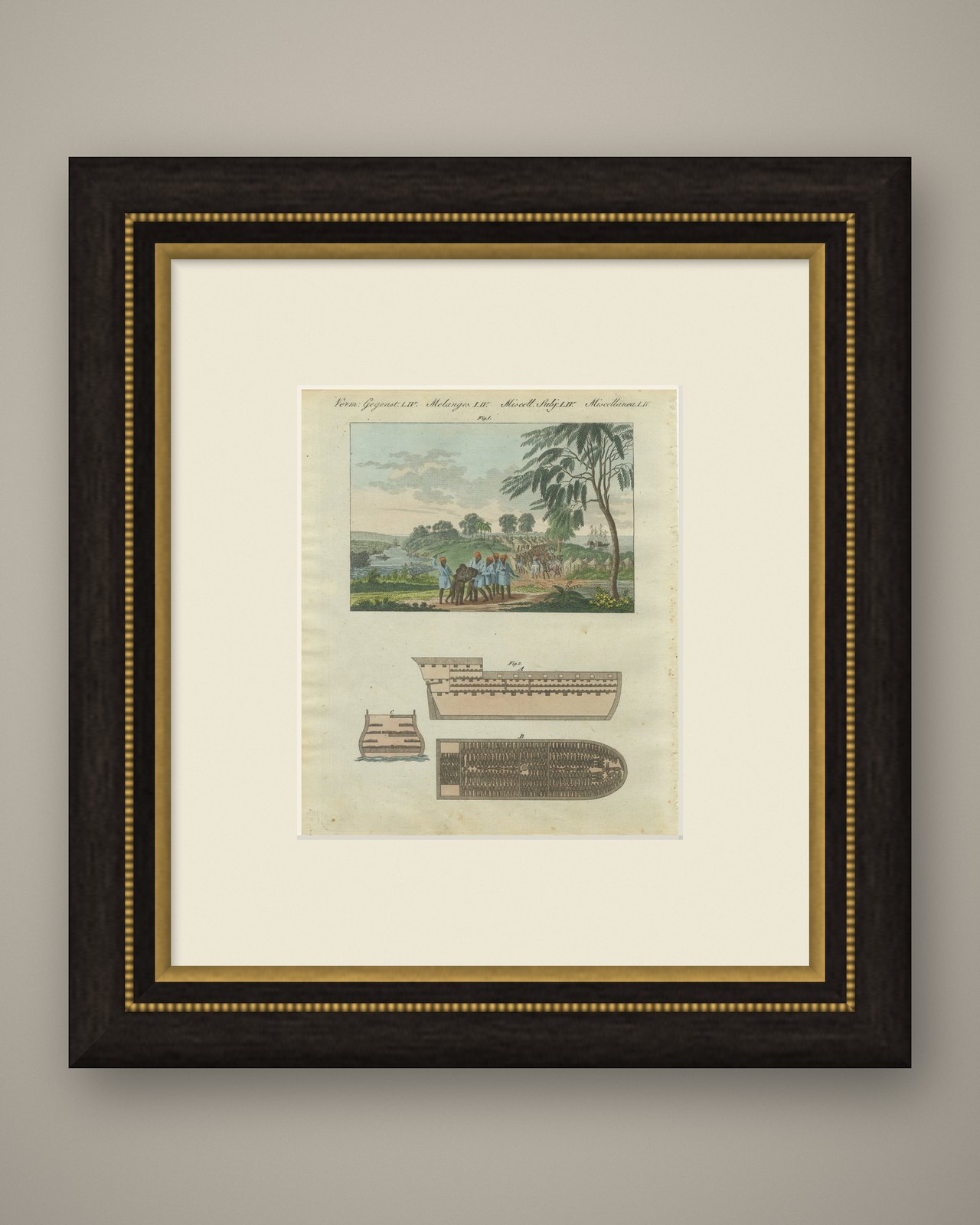


Frame and rooms are illustrations of how the piece could look; it is sold unframed unless the description says otherwise.
Bertuch African Slave Trade & Slave Ship Engraving, 1805
£580£43525% off
$575 · €522
Original print, not a reproduction.
Ships worldwide from the Netherlands, flat or rolled, insured and tracked. 14-day returns.
- Date
- 1805
- Sheet size
- 9.4 × 7.9 in (24 × 20 cm)
- Condition
- Good. Wear consistent with age and use. Good antique condition with age-related toning, scattered foxing and spotting, particularly within the margins. Some minor surface marks and handling wear consistent with age. Original or early hand coloring remains attractive.
- Collection
- Ships & sea battles
- Era
- 1790 to 1849, Age of sail
- Stock no.
- BG-14387
What the condition grades mean
- Excellent
- Bright and clean, with no faults worth mentioning.
- Very good
- Only light signs of age, such as faint toning.
- Good
- Normal signs of age for a sheet of this period: toning, some foxing, small marks or neat old repairs.
- Fair
- Clear faults such as staining, tears or repairs, priced to match.
Every fault we see is written in the condition note, and the whole sheet is shown uncropped in the photos.
Bertuch African Slave Trade & Slave Ship Engraving, 1805
Description:
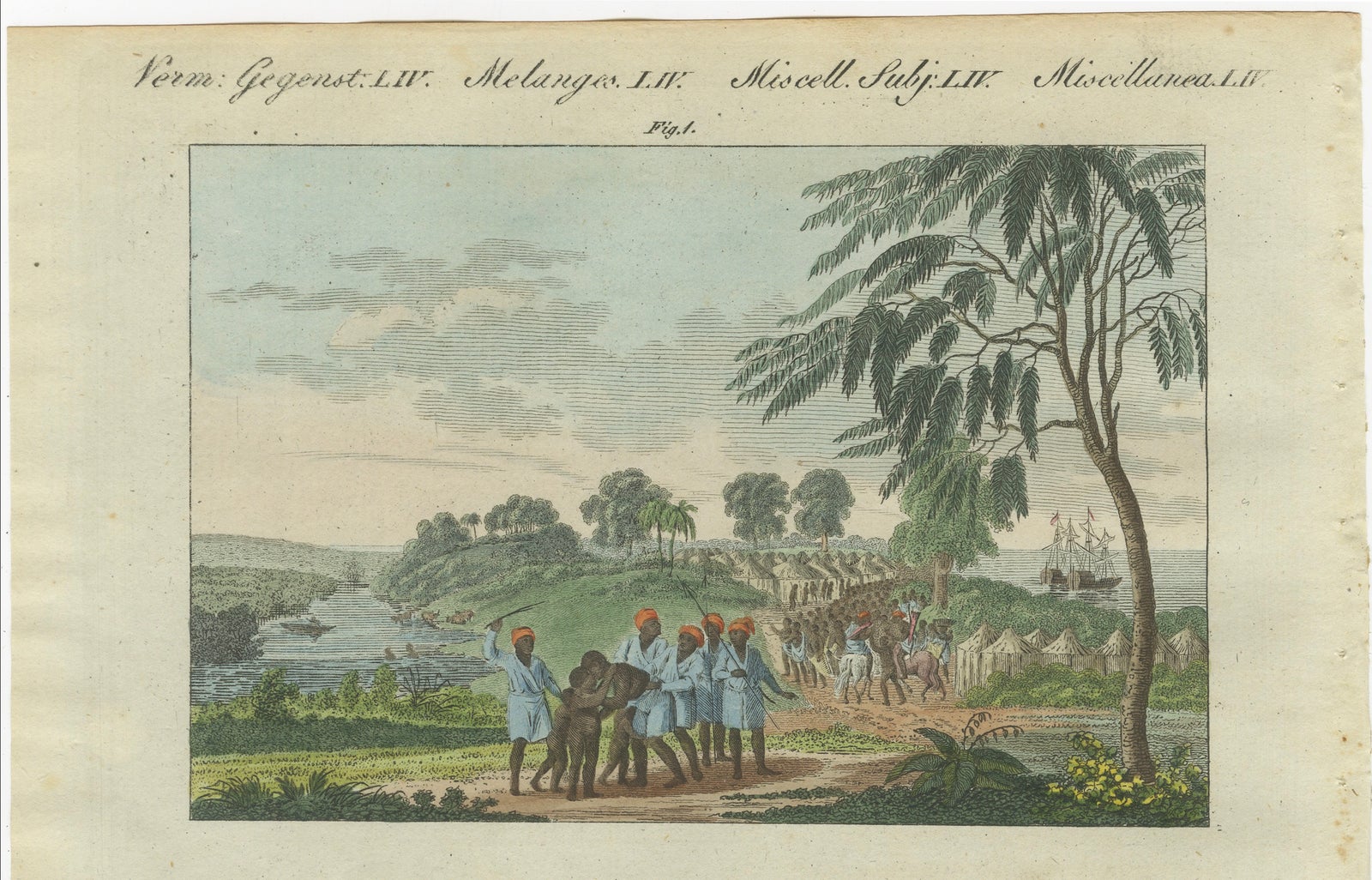
Original antique hand-colored copperplate engraving illustrating the transatlantic slave trade, published by Friedrich Justin Bertuch in his celebrated Bilderbuch für Kinder in Weimar, 1805.
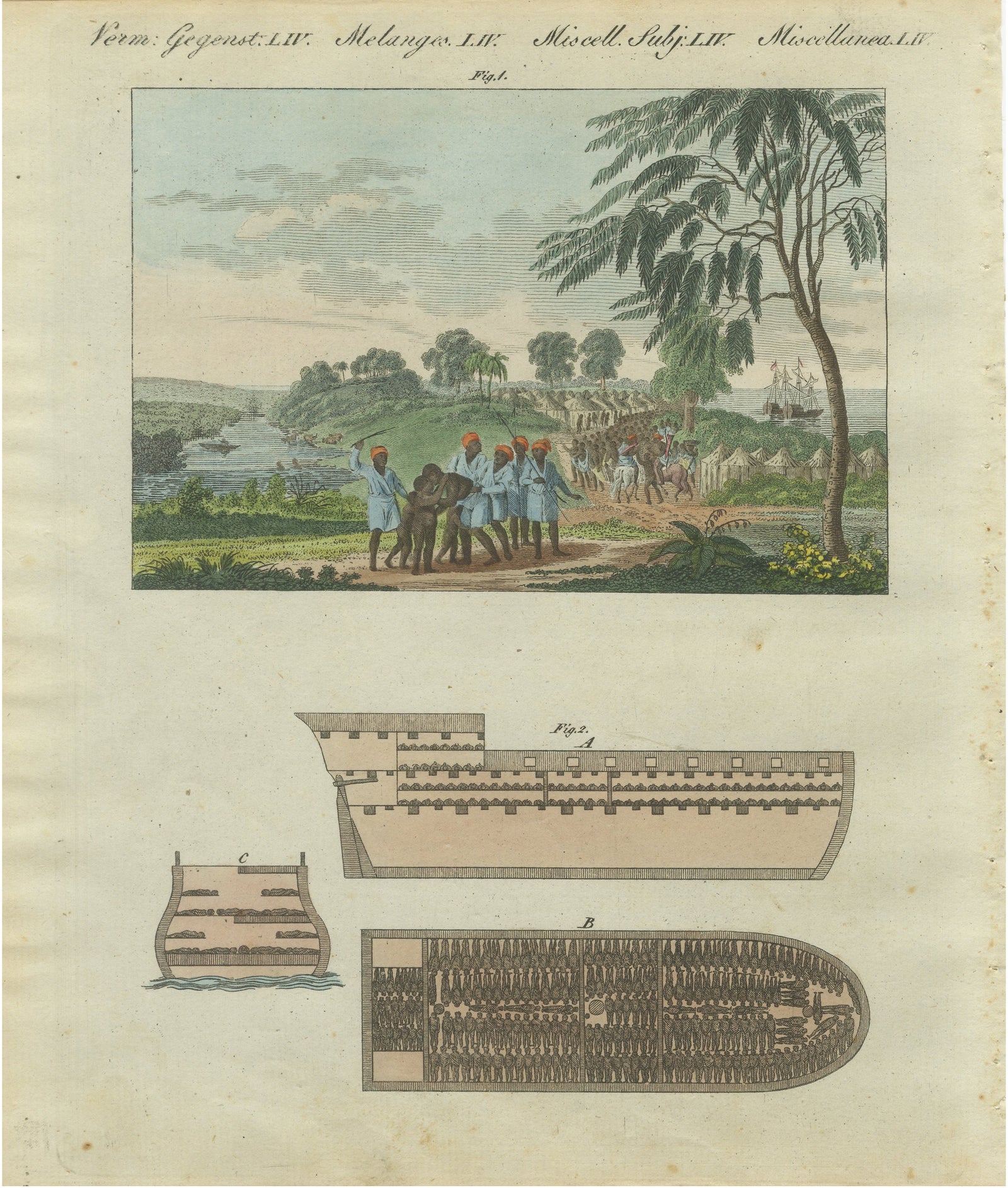
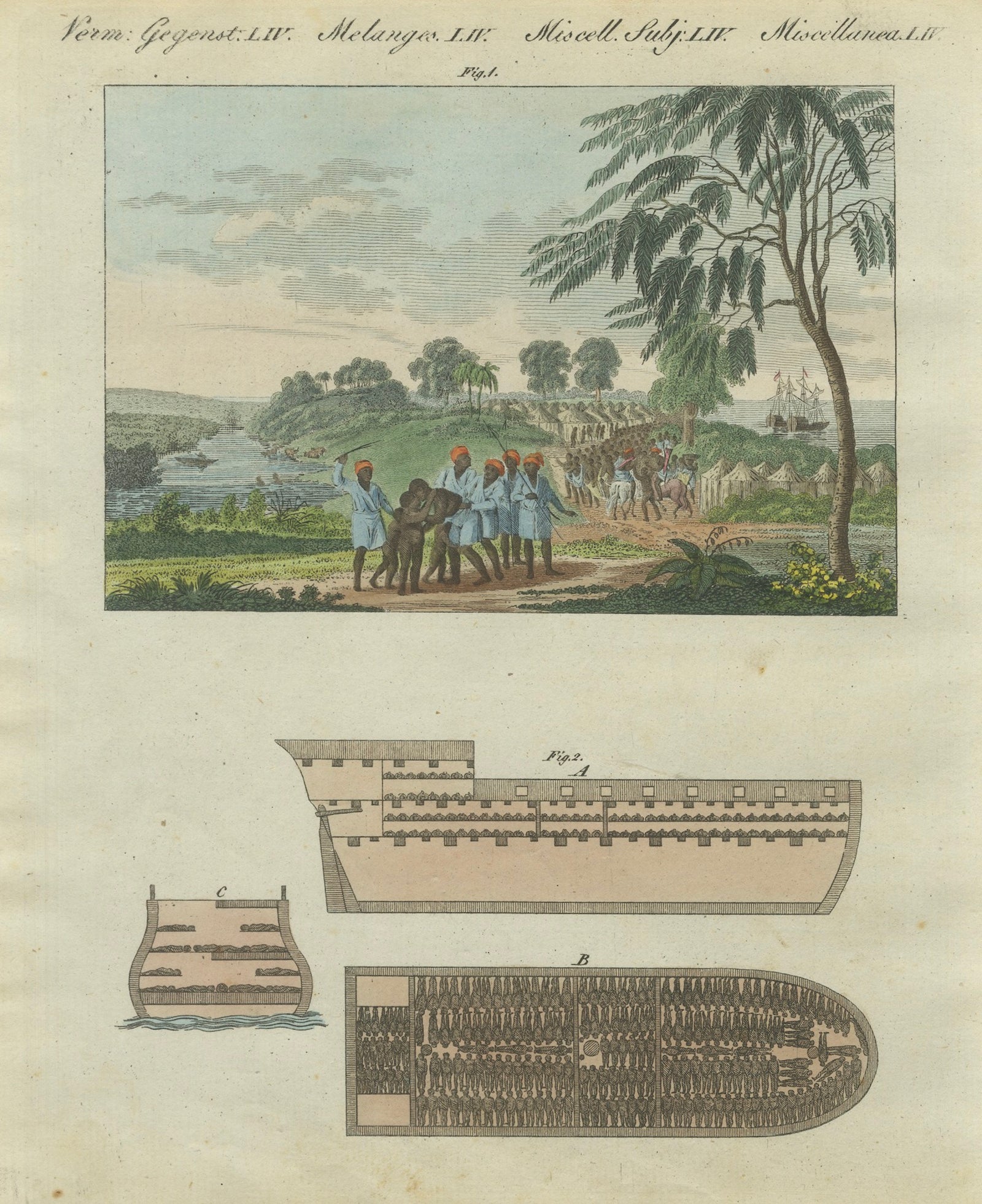
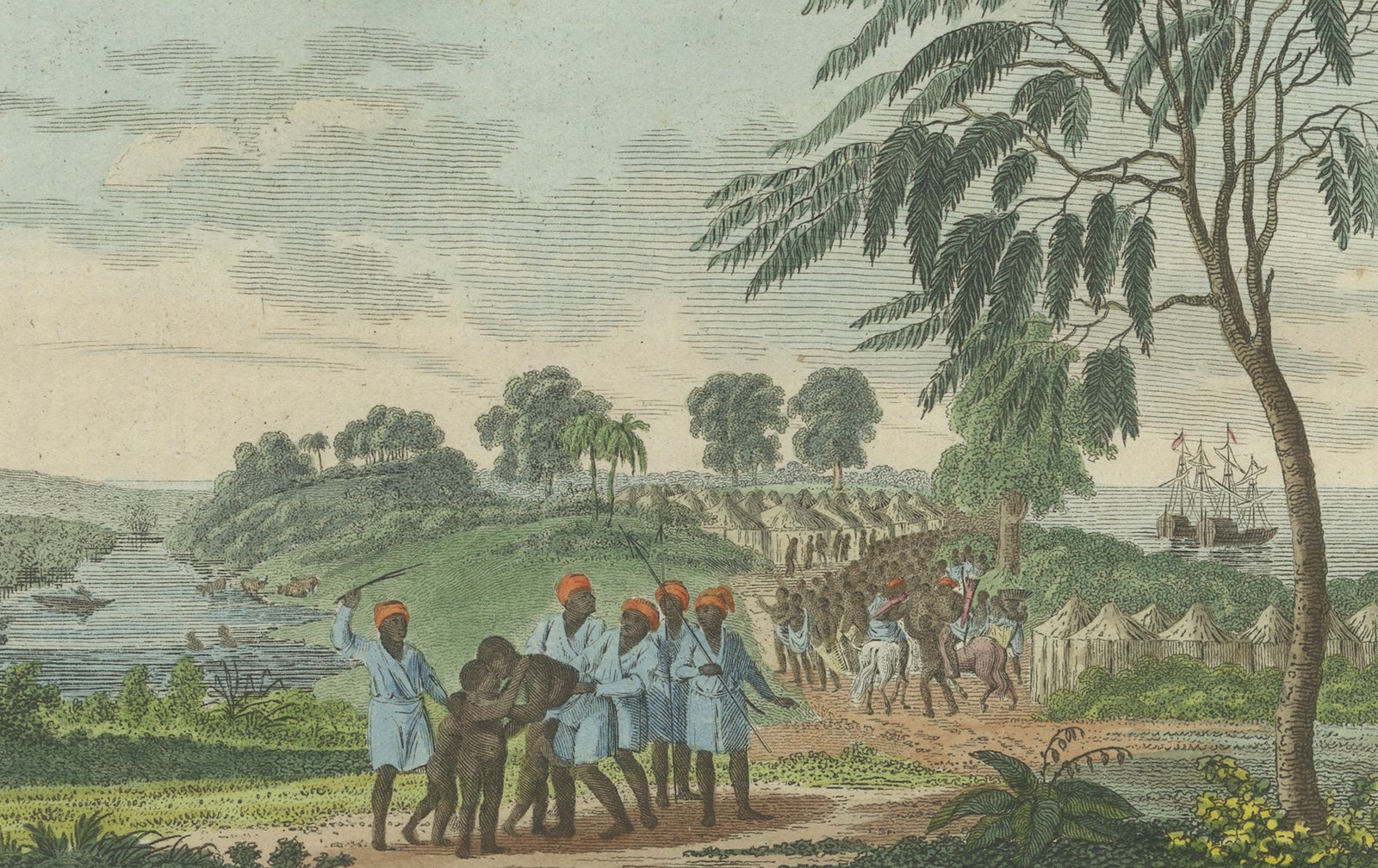
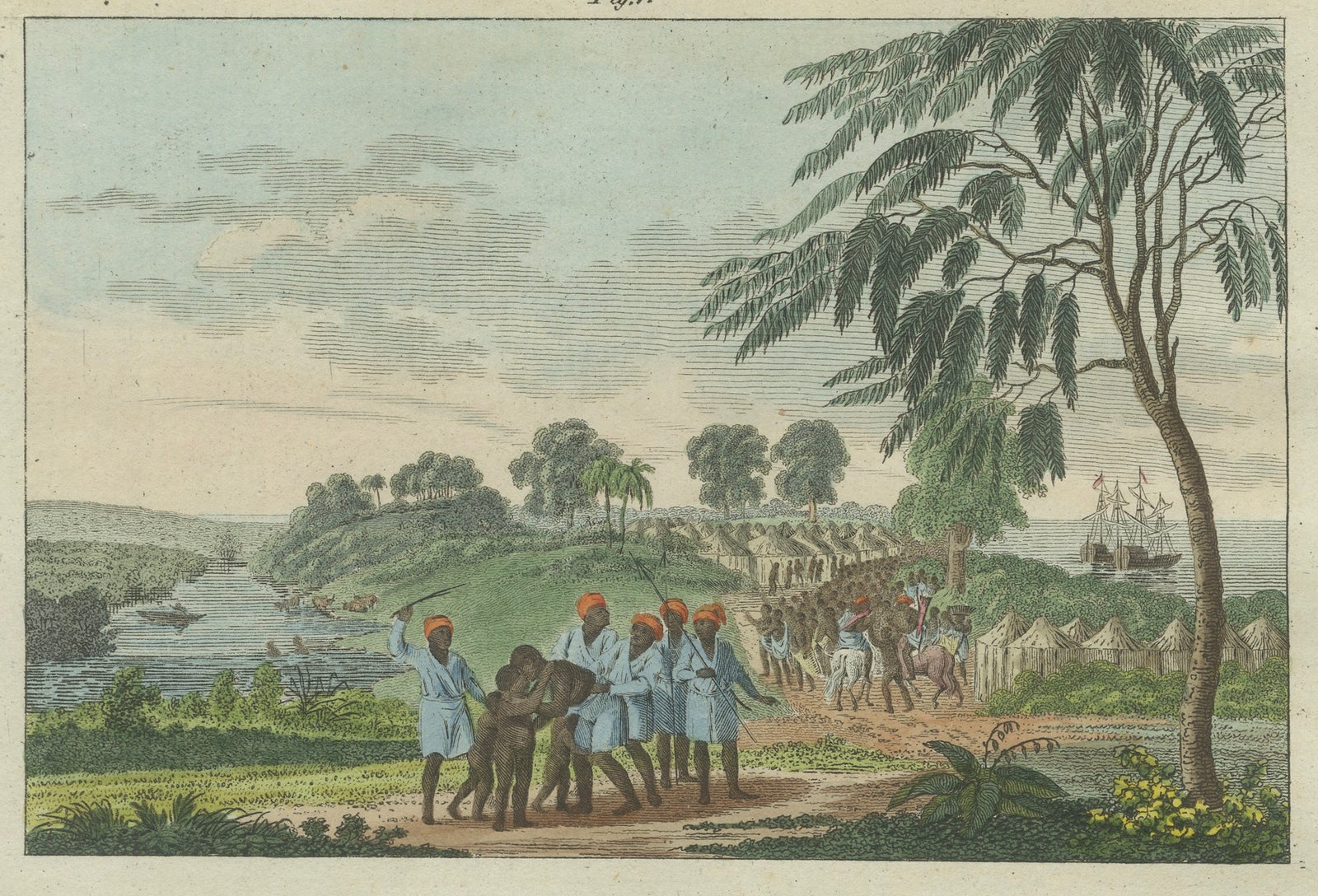
The upper scene depicts a coastal landscape in Africa, where captive Africans are shown being detained and assembled by armed traders. A procession approaches an encampment near the coast, while a European sailing ship lies offshore. The deceptively picturesque landscape contrasts starkly with the subject represented.
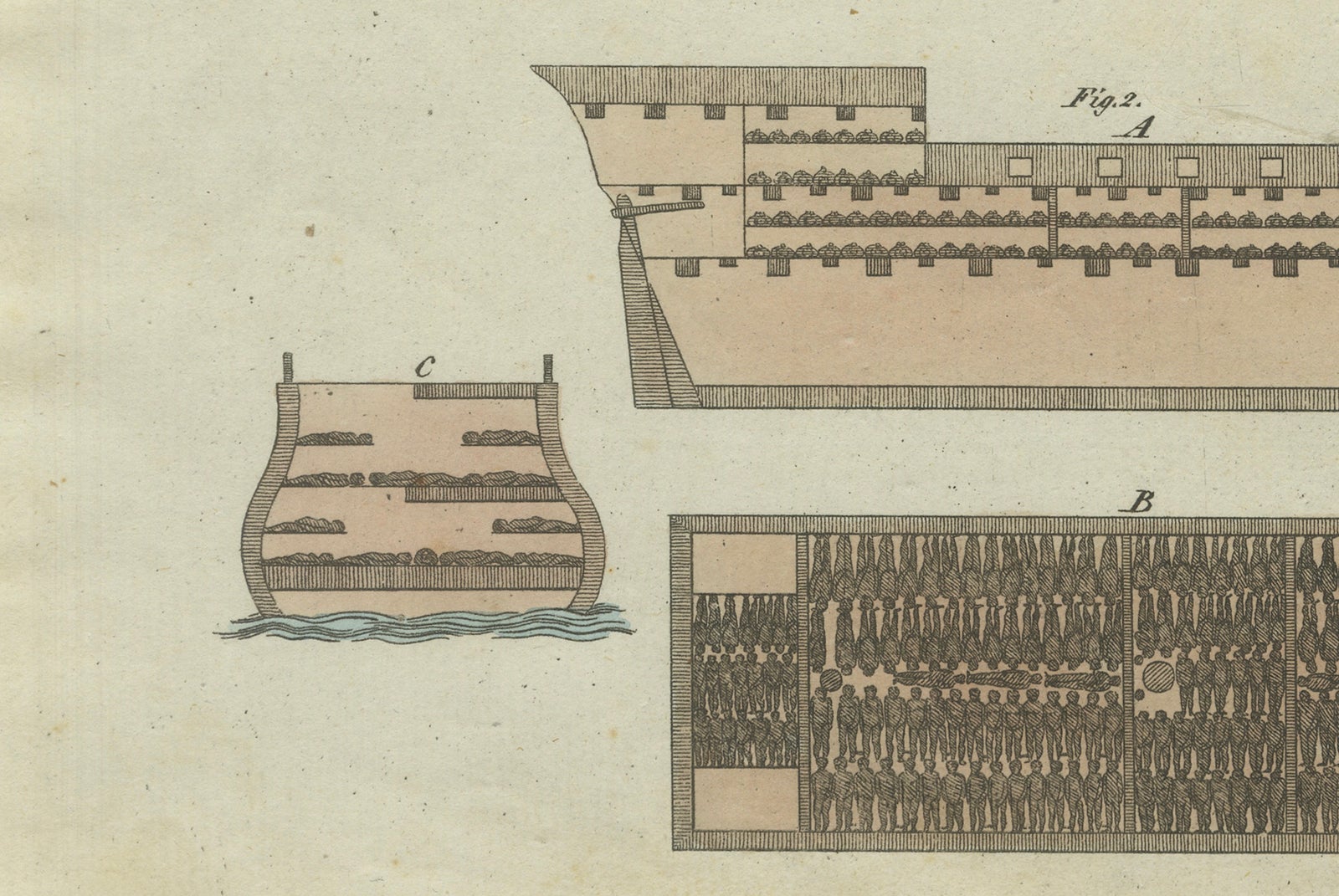
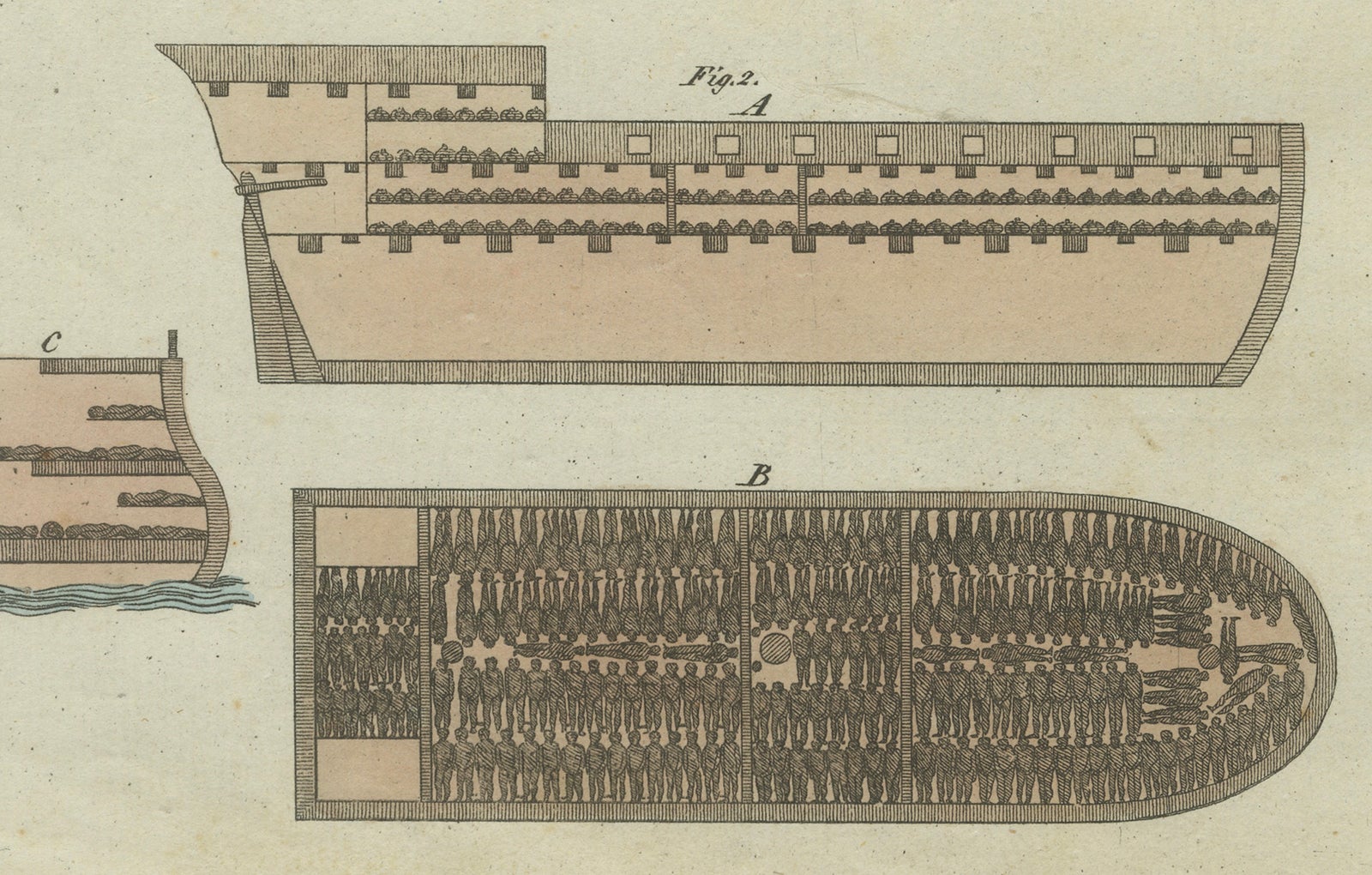
The lower half contains three detailed diagrams illustrating the confinement and transportation of enslaved people aboard a slave ship. These include a longitudinal section, a plan of the densely packed lower deck, and a transverse section showing the extremely restricted spaces in which people were transported during the Middle Passage.
The diagrams belong to the visual tradition made famous by abolitionist representations of the British slave ship Brooks (also spelled Brookes), whose plans became one of the most influential images used to expose the conditions of the transatlantic slave trade. Bertuch's plate adapted this subject for his educational encyclopedia and demonstrates how information about the slave trade and its conditions circulated in continental Europe around 1800.
Published in Friedrich Justin Bertuch's Bilderbuch für Kinder, an ambitious illustrated encyclopedia created to introduce young readers to subjects ranging from natural history and geography to technology, cultures and contemporary events.
The combination of the hand-colored African scene with technical diagrams of a slave ship makes this an unusually striking historical document relating to slavery, the Middle Passage, European perceptions of Africa and the abolition era.
Friedrich Justin Bertuch (1747–1822)
Bilderbuch für Kinder
Weimar, Germany
1805
Original hand-colored copperplate engraving
This is an original antique engraving published in 1805, not a modern reproduction.
Good antique condition with age-related toning, scattered foxing and spotting, particularly within the margins. Some minor surface marks and handling wear consistent with age. Original or early hand coloring remains attractive. Please study the photographs carefully as they form part of the condition description.
Period
Early 19th Century
Style
Neoclassical
Historical
Educational
Abolition Era
Medium
Hand-colored copperplate engraving
Subject
Transatlantic Slave Trade
Slave Ship
Middle Passage
Africa
Maritime History
Abolition
African History
Colonial History
EXPLORE